


|
Getting your Trinity Audio player ready...
|
Your brand ranks on page one of Google. Your SEO dashboards are green across the board. Yet when a prospective buyer asks ChatGPT, Perplexity, or Google AI Overviews to recommend vendors in your category, your company doesn’t appear in the results. This is the disconnect thousands of executives are now confronting: strong search rankings paired with near-total invisibility inside AI-generated answers.
Traditional SEO tools were built to measure how humans interact with search engines, click-through rates, keyword positions, and backlink profiles. They were never designed to capture whether your brand appears in AI responses generated by large language models. As AI assistants and AI search engines rapidly become the first touchpoint for buyer research, product comparisons, and vendor discovery, this gap in visibility data represents a strategic blind spot that no leadership team can afford to ignore.
AI visibility matters because the way people find, evaluate, and choose businesses is fundamentally shifting. When AI platforms like ChatGPT, Perplexity, and Google Gemini mediate the discovery process, brands that are absent from those AI responses lose influence at the most critical moment, before the buyer even knows your company exists. For competitive positioning, lead generation, and long-term brand perception, this is no longer a niche technical concern. It is a core business strategy issue.
Let’s explore what AI visibility means and how it impacts your business growth strategy.
Ai Visibility
AI visibility is the measurable frequency and prominence with which a brand appears in AI generated answers across major AI platforms-and its absence can erode growth, market share, and competitive standing regardless of how well traditional SEO performs.
What Is AI Visibility?
AI visibility refers to how often, how prominently, and in what context your brand, products, or services are surfaced by AI driven search platforms and AI assistants when users ask questions relevant to your industry. Unlike traditional search engines, which present a list of links for users to evaluate, AI systems synthesize information and present direct recommendations, comparisons, and explanations. AI visibility measures whether your brand is part of that synthesized output.
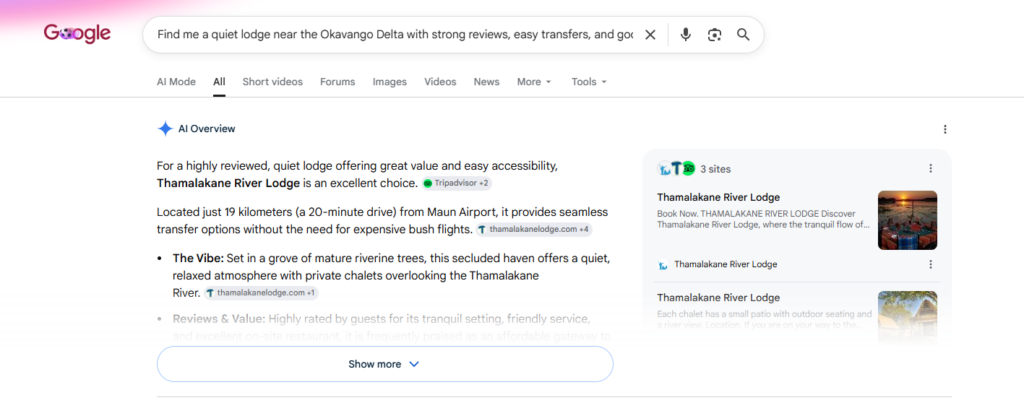
There are two core dimensions to understand:
- AI mentions: when an AI response includes your brand name or product name within its answer, even without a direct link. AI brand mentions build recognition and influence buyer consideration.
- AI citations: when the AI model references your specific content, domain, or page as a source, often with attribution or a link. Citations carry stronger persuasive weight and drive direct traffic.
AI visibility is how often and how prominently your brand appears in AI assistant responses and generative search engines when users ask relevant questions-distinct from search rankings in traditional search engines, which measure your position on a results page, not whether you are cited or recommended by AI systems.
The AI platforms that matter most include ChatGPT, Google AI Overviews, Google AI Mode, Perplexity, Gemini, Claude, and DeepSeek. Each uses different retrieval models and training data, meaning your brand’s AI visibility can vary significantly across platforms. Some AI engines crawl content in near real-time; others rely on periodic indexing or structured data signals. A comprehensive approach to AI visibility tracks performance across all of them.
Why AI Visibility Matters for Business Leaders
The Shift in Buyer Research Behavior
Buyer behavior has moved decisively toward AI platforms. A Gartner 2025 survey of 645 B2B buyers found that 45% of respondents used generative AI to gather information on vendors and products. On the consumer side, a Trustpilot study showed over 58% of consumers now use AI to discover products and services. These are not edge cases-AI search is becoming a mainstream channel for early- and mid-funnel research.
Critically, 69% of B2B buyers now turn to sales reps to validate AI-generated insights, meaning they used AI first. If your brand doesn’t show up when AI talks about your category, your sales team never gets the chance to validate anything.
Connection to Measurable Business Outcomes
AI visibility translates directly to brand performance metrics that matter to the C-suite:
- Incremental revenue from AI-discovered leads: when your products are surfaced in AI recommendations, users who accept those suggestions become new leads or direct sales opportunities. One D2C e-commerce brand with approximately $8M in revenue went from zero AI presence to $180K/month in AI-attributed revenue within 90 days.
- Brand awareness and credibility: being cited by AI models bolsters perceived authority. When an AI answer engine names your brand as a top solution, it shapes brand perception for every user who reads that response.
- Competitive defense: competitors will occupy your space in AI responses if you don’t. Invisibility cedes share of voice-and market share-to rivals who invest in their AI presence.
- Lower acquisition cost per attention: unlike paid ads, being organically surfaced in AI responses functions as earned media exposure at scale.
- Compressed buying cycles: buyers who discover your brand via AI at the comparison stage enter your funnel earlier and with higher intent, reducing friction for your sales team.
For business leaders focused on strategic business reviews and growth planning, AI visibility is now a leading indicator of future pipeline health.
How AI Visibility Works: Key Components
Understanding how AI visibility works requires breaking it down into its core elements:
Brand Mentions Across AI Platforms
AI visibility tracks whether your brand shows up when users query AI systems with category-level prompts such as “best project management tools for enterprise” or “top CRM for mid-market.”
The mention rate the percentage of relevant prompts where your brand appears is the foundational metric. Custom prompt tracking across different query types, including comparisons, “best X,” how-to, and vendor research, reveals where your brand appears and where visibility gaps exist.
Domain Citations and Source Attribution
Beyond mentions, citations measure whether AI bots pull from your content as a source. Techniques such as machine-readable structured data, schema markup (e.g., FAQPage, Article, Product), answer-first content formatting, and explicit statistics with sourcing all increase the likelihood that AI models will cite your domain. This is where generative engine optimization (GEO) and answer engine optimization converge.
Competitive Positioning and Share of Voice
AI visibility measurement is not just about your own brand; it includes benchmarking against key competitors. Share of voice in AI responses indicates whether you are the dominant recommendation, one of several, or entirely absent relative to rivals. This competitive positioning data is essential for strategic planning.
Platform Coverage
Each AI model behaves differently. For example, Google AI Overviews rely on the Google index, Perplexity conducts on-demand web crawling, and ChatGPT draws from training data and supplemental retrieval. Your overall visibility depends on your presence across multiple platforms, not just one. An AI visibility tool or performance monitoring system should cover all major AI platforms.
Traditional SEO vs. AI Visibility Metrics
Traditional SEO tools measure keyword rankings, organic traffic, and backlinks, which are critical for search visibility in traditional search engines but insufficient for AI search performance. In multiple documented cases, content ranking on page one of Google had zero AI citations until it was restructured for AI consumption. Unlike traditional SEO, AI visibility requires content that is easily extractable, clearly structured, and backed by verified trust signals.
Understanding these components helps leaders see AI visibility not as a replacement for SEO, but as a parallel strategic layer that demands its own analytical processing and investment.
Real-World Business Case
Consider a mid-market B2B SaaS company in the marketing automation vertical. Despite having 34 well-optimized pages and strong Google rankings, the company had zero AI citations across major AI platforms. Their brand was invisible to every AI assistant their buyers were using.
The company undertook a focused restructuring effort-no new content creation, no link building-limited entirely to structural improvements: answer-first paragraph formatting, schema markup implementation (Article, FAQPage, Person), and explicit data sourcing throughout existing pages. Within 45 days, the results were dramatic:
- 40% mention rate on Perplexity
- 27.5% mention rate on ChatGPT
- 22.5% mention rate on Claude
- 17% mention rate on Gemini
Separately, a global FMCG brand used prompt-level monitoring and content feed normalization to increase visibility from 12% to 38% and citation rate from 4% to 22% within eight weeks-while simultaneously reducing competitor share of voice in AI responses.
These cases demonstrate that AI visibility improvements are achievable on compressed timelines and produce measurable impact on brand recognition, lead quality, and competitive positioning. The strategic outcome is clear: brands that invest in AI visibility gain influence over the AI-mediated discovery process that increasingly shapes buyer decisions.
Building Your AI Visibility Strategy
Assessing Your Current AI Presence
Start with an audit. Select 200+ prompts that mirror how your target audience searches-vendor comparisons, “best X” queries, feature-specific questions, and industry how-tos. Run these across ChatGPT, Gemini, Perplexity, and Claude. For each prompt, record whether your brand shows up, whether your content is cited, and how you compare against competitors.
Many organizations discover that their brand’s presence in AI responses is far weaker than their traditional search visibility would suggest. A free AI visibility checker or dedicated AI visibility tool can accelerate this initial assessment with just a few clicks.
Measuring and Tracking Progress
Define your core visibility metrics:
- Mention rate: percentage of relevant prompts where your brand appears in AI responses
- Citation rate: percentage of prompts where your content is used as a source
- Share of voice: your AI brand mentions relative to competitors
- Platform coverage: presence across all major AI platforms
- AI-attributed leads/revenue: downstream business outcomes tied to AI discovery
Set baselines and establish monthly targets. For example, moving citation rate from 4% to 20% in eight weeks is an achievable benchmark based on documented cases.
Incorporate deeper insights through statistical confidence intervals-AI visibility data is an estimator with variance, so reporting capabilities must account for prompt sample diversity and platform-specific behaviors, as highlighted by recent academic frameworks on quantifying uncertainty in AI visibility.
Integration with Existing Efforts
AI visibility should not be a standalone initiative. It piggybacks on existing content marketing, domain authority, and SEO investment. Structural improvements to content benefit both traditional search and LLM visibility. Review management feeds into reputation strategy. PR and authoritative third-party mentions strengthen entity recognition across AI models.
Teams involved should include content strategists, technical SEO specialists, product teams (for feed data and product schema), customer success teams managing review profiles, and analytics professionals building attribution models.
Resource Allocation and ROI
Budget for schema implementation, content auditing and restructuring, AI visibility monitoring tools, and review management. Many case studies show measurable gains in 4–12 weeks with focused effort. Perplexity tends to reflect structural changes within days; ChatGPT and Gemini may take weeks due to indexing cycles.
For opportunity sizing, consider that documented case studies show revenue attribution ranging from doubled MQLs to $180K/month in direct AI-attributed revenue-figures that make the investment case straightforward for most organizations.
Conclusion
AI visibility is no longer an optional marketing metric it is a critical business imperative for 2027 and beyond.
As buyer behavior shifts toward AI-powered discovery, brands must ensure they appear accurately and prominently in AI-generated answers across platforms like ChatGPT, Gemini, and Perplexity. Achieving strong AI visibility requires a strategic blend of content structuring, technical optimization, and ongoing measurement that complements traditional SEO efforts.
By investing in AI visibility, business leaders can protect their brand’s market share, accelerate lead generation, and build lasting competitive advantage in an AI-mediated marketplace. Start with a comprehensive audit, implement targeted improvements, and track progress regularly to turn AI visibility into a powerful growth lever for your organization.
Frequently Asked Questions
How does AI visibility differ from traditional digital marketing metrics?
Traditional SEO and digital marketing metrics-keyword rankings, organic traffic, click-through rates-measure how your brand performs in traditional search engines. AI visibility measures something fundamentally different: whether your brand appears in AI-generated answers when users query AI assistants like ChatGPT, Gemini, or Perplexity. Content that ranks well on Google can have zero AI citations if it isn’t structured for AI extraction. The strategic implication is that brands need both sets of metrics to understand their true online visibility and search visibility across all discovery channels.
What’s the ROI timeline for investing in AI visibility?
Most documented cases show significant improvements in AI search performance within 4–12 weeks of focused effort. Structural changes (schema markup, answer-first formatting) can produce results on platforms like Perplexity within days. Broader gains across ChatGPT and Gemini typically emerge over 6–8 weeks. Revenue attribution varies by business model, but case studies report outcomes ranging from MQL volumes doubling to six-figure monthly revenue directly attributable to AI discovery channels. Set realistic expectations by platform-and invest in performance monitoring to track visibility trends over time.
Should AI visibility be prioritized over traditional SEO for B2B companies?
It shouldn’t be an either/or decision. Traditional SEO builds domain authority and organic search visibility that AI models often use as input signals. AI visibility ensures your brand’s presence in the AI-mediated discovery layer where a growing share of B2B buyers now begin their research. The most effective approach integrates both: use existing SEO investment as a foundation, then layer in GEO data strategies, structured data optimization, and prompt tracking to capture the AI channel. Resource allocation should reflect the growing share of buyer journeys that now start with AI platforms.
How can executives measure AI visibility without technical expertise?
Business leaders don’t need to be technical experts to track their brand’s AI visibility. Third-party AI visibility tools and platforms provide management dashboards showing mention rates, citation rates, share of voice, and visibility trends across major AI platforms. Commission an initial audit from a specialized provider, then monitor key metrics monthly. Track downstream indicators your teams already understand-leads, demo requests, pipeline influenced-and correlate with AI visibility data. The key is ensuring your reporting capabilities include AI-specific metrics alongside traditional marketing dashboards.
What are the competitive risks of ignoring AI visibility in 2027?
The risks are significant and accelerating. As AI becomes a dominant interface for search and discovery, brands invisible to AI systems risk being excluded from the recommendation flow entirely-ceding share of voice, early-funnel influence, and category credibility to competitors who invest. With 45% of B2B buyers already using AI for vendor research, invisibility in AI may soon equate to market invisibility. There is also a misinformation risk: if competitors’ content fills the vacuum, AI models may present inaccurate or unfavorable information about your brand. Proactive AI visibility strategy is a defensive necessity as much as a growth opportunity-a new dimension of the competitive forces shaping every industry.