


|
Getting your Trinity Audio player ready...
|
Most CEOs look at Nike and see a swoosh. They look at Apple and see a minimalist piece of fruit. They see the visuals, the aesthetic “uniform” of the company, but they completely miss the General standing behind the Soldiers.
In the business “War Room,” the logo is just the uniform; it identifies which side you are on. The Brand Strategy, however, is the battle plan. It is the intelligence, the logistics, and the psychological edge that determine whether you win the market or retreat into the shadows of commoditization.
If your brand feels like it’s just a series of disconnected transactions rather than a growing community of advocates, you don’t have a design problem; you have a fundamental strategy problem. You are sending soldiers into the field without a map.
Brand Strategy
A brand strategy is a comprehensive plan that outlines how a business will position, differentiate, and communicate its brand to target audiences to achieve its business goals.
What is Brand Strategy?
Brand strategy is a long-term, behavior-driven plan to develop a successful brand and achieve specific business goals. It is a comprehensive framework that defines your Brand Heart (the “why” that filters every decision), your Strategic Identity (the “where” you sit in the competitive landscape), and your Behavioral Narrative (the “how” you forge an emotional contract with your audience).
Unlike a marketing plan, which focuses on short-term tactics, channel spend, and campaign cycles, a brand strategy focuses on the enduring questions: Who are you at your core, and why should the world care?
Why Your Brand Is Not Your Logo
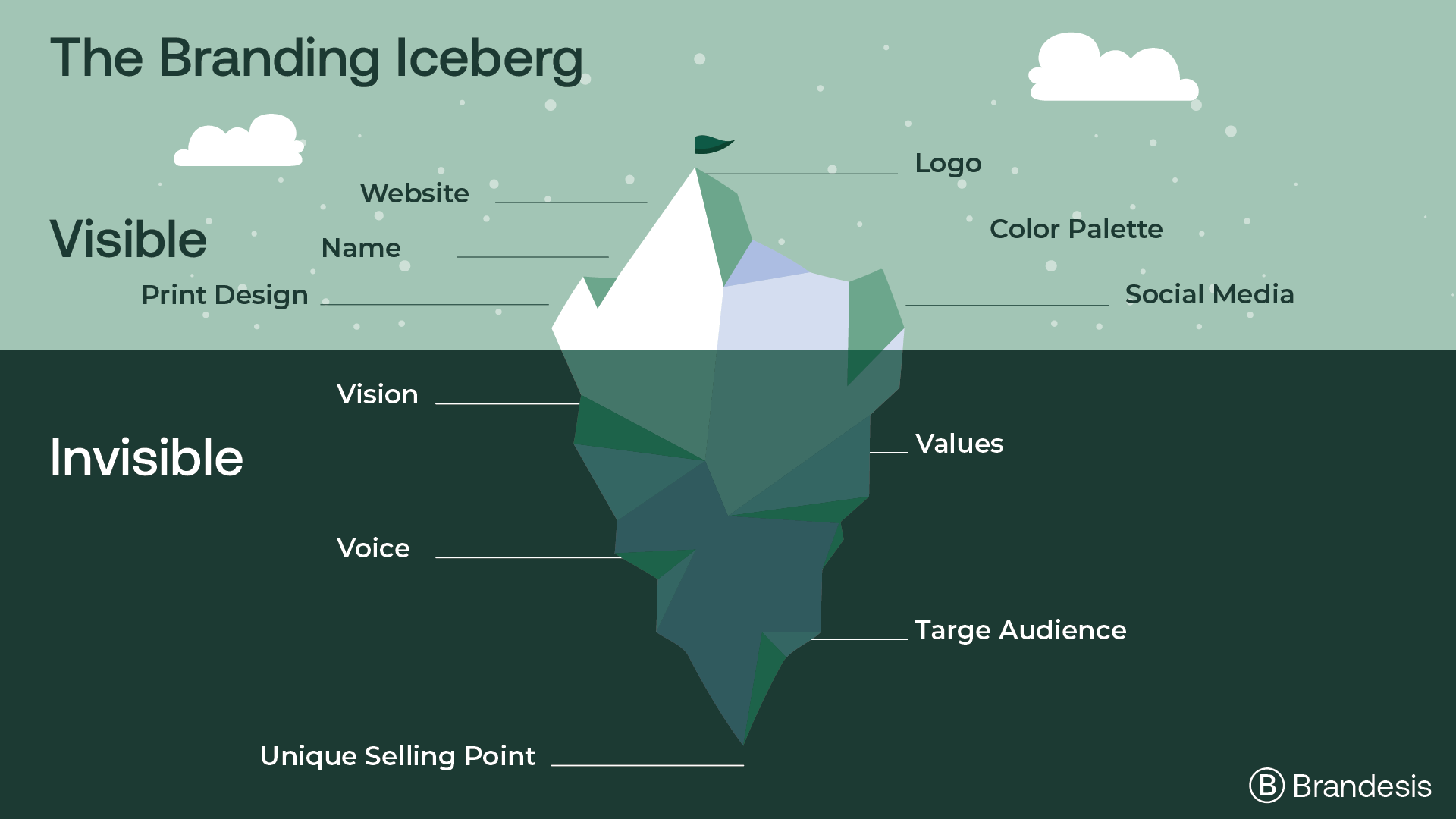
A common mistake founders make is treating branding as a cosmetic exercise—a “fresh coat of paint” for a crumbling structure. You hire a designer, get a “pretty” logo, and then wonder why your customer acquisition cost (CAC) remains high and your churn rate refuses to budge.
A logo is merely a symbol of trust. But if there is no strategy behind it, that symbol is an empty vessel. Strategy is what gives that symbol weight, meaning, and gravity. It is the reason why a customer will willingly pay a 16% premium for your services while your competitors are forced to slash prices to stay in the conversation.
Without the foundation (the submerged mass of the iceberg comprising internal culture, customer experience, and strategic intent), the logo will eventually sink under the weight of market indifference.
The Brandesis Difference: Behavior-Driven Storytelling
At Brandesis, we move beyond the “Brand Shop” mentality of simply producing print and stationery. We focus on the “Genesis” of connection through behavioral insights.
We don’t just ask what people buy; we ask why they believe.
- Why do people choose you over a cheaper alternative? It’s rarely about the features; it’s about the unspoken alignment of values.
- What is the “Genesis” of their trust? We identify the exact moment a stranger decides you are the “safe” or “aspirational” choice.
- How do we move them from ‘stranger’ to ‘advocate’ before they even click buy? By the time they reach your sales team, the “sale” should already be 80% complete because the narrative has done the heavy lifting.
By understanding the cognitive biases and psychological triggers of your audience, we craft a strategy that doesn’t just “reach” people, it resonates with their identity.
Strategic Foundations: Brand vs. Marketing
To truly understand how strategy dictates direction, it’s helpful to see the two in action. This expert breakdown illustrates why marketing without a brand strategy is just “noise.”
The Core Pillars of a World-Class Brand Strategy
1. The Brand Heart (The “Why”)
Before you can tell your story to the world, you must unearth your truth. This involves identifying your purpose, vision, mission, and values. As we always say at Brandesis, your Brand Heart is the filter for every business decision.
When your “Heart” is clear, you no longer have to guess how to respond to a crisis or a new market opportunity; the answer is already written in your DNA.
2. Strategic Positioning (The “Where”)
Where do you sit in the competitive landscape? To win, you must move beyond “better” and aim for “different.” If you are merely “better” than your rival, you are still playing their game.
If you are “the only” solution for a specific group of people, you own the board. Positioning is about finding that unique market gap and defending it with an authentic story that makes your competitors irrelevant.
3. Brand Messaging (The “How”)
Your messaging framework is the “voice” of your strategy. It ensures that every tweet, annual report, and website page speaks with a consistent, coherent authority.
When your messaging is fragmented, your brand looks like a collection of strangers. When it is unified, it looks like a leader.
SEO & AEO: Being the Answer in the Age of AI
Optimizing for the future: Moving from search results to definitive AI answers.
In the age of AI, the digital landscape has undergone a seismic shift. Customers are no longer just typing “best brand agency” into a search bar; they are asking conversational AI assistants for nuanced recommendations: “Which agency focuses on behavioral insights for scaling startups?”
A world-class Brand Strategy now includes Answer Engine Optimization (AEO) and Generative Engine Optimization (GEO). Because your brand strategy defines your “Truth” in clear, structured terms, it allows AI systems to accurately summarize, categorize, and, most importantly, trust your brand.
If your brand presence is incoherent or lacks a strategic core, AI won’t recommend you. If your strategy is solid, you become the definitive, trusted answer.
The ROI of a Strategic Foundation
Investing in a high-level strategy yields three critical business results that go straight to the bottom line:
- Lower Friction & CAC: Trust-based storytelling warms up leads and lowers the barrier to entry. When customers already “know” who you are through your narrative, the sales cycle is shorter and more efficient.
- Increased Enterprise Valuation: A clear brand strategy builds “Brand Equity”—an intangible asset that shows up on the balance sheet. Strategic brands are consistently valued higher in acquisitions and funding rounds because they represent a “sure thing” to investors.
- Internal Team Alignment: A strong brand strategy serves as the blueprint for your Employer Brand. It attracts talent that doesn’t just want a paycheck, but wants to join your mission. This reduces turnover and turns your employees into your most vocal brand ambassadors.
Next Steps: Is Your Brand Ready to Lead?
Your story is your most potent competitive edge in a crowded, noisy marketplace. Don’t leave your most valuable asset to chance or let it be defined by a logo alone.
- Step 1: Conduct a Brand Audit to uncover where your current narrative is leaking trust.
- Step 2: Explore our Ultimate Guide to Brand Strategy for a deep dive into the Brandesis “War Room” methodology.
- Step 3: Ready to move beyond the transaction? Let’s Talk.
Tell Your Story. Build Your Brand. Grow Your Community.
FAQ: Frequently Asked Questions About Brand Strategy
Can we just start with a logo and do the strategy later?
You can, but it’s the most expensive mistake a founder can make. Starting with a logo without a strategy is like picking a uniform before you’ve decided which war you’re fighting. You will likely have to redo it in 18 months once you realize your visuals don’t align with your market reality.
How do I know if my brand strategy is working?
Look for three indicators: a decrease in your sales cycle length (trust), an increase in your ability to charge a premium (positioning), and your employees’ ability to describe what you do without looking at a script (alignment).
What is the difference between Brand Strategy and Marketing?
Brand strategy is the Identity (who you are); Marketing is the Tactics (how you get attention). Strategy is the engine; Marketing is the fuel. If your engine is broken, adding more fuel won’t get you to your destination.
How long does the brand strategy process take?
At Brandesis, our intensive “War Room” phase typically takes 4–8 weeks. However, the strategy itself is an evergreen asset that evolves as your business grows.